

Free Speech and the Fragility of Truth: Why Free Speech and Liberty Still Matter — Free Speech and Liberty
- Brad Riley
- Mar 31
- 3 min read

Free Speech and the Fragility of Truth: The Crisis of Free Speech and Liberty
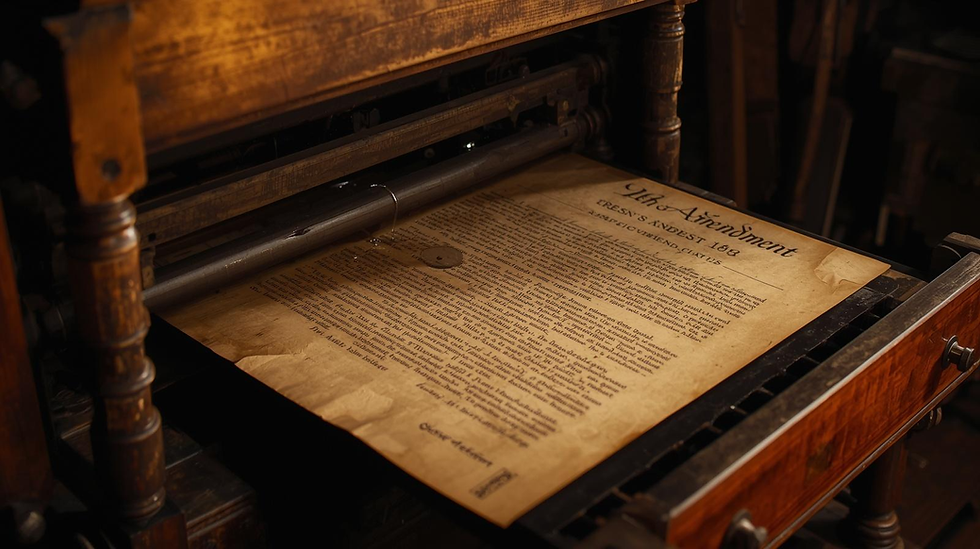
The American experiment in liberty rests on a simple but demanding assumption: truth can withstand examination. The founders believed that a free people must be able to speak, debate, and reason together without fear of punishment. Free speech and liberty were not seen as separate ideas, but as inseparable pillars of a self-governing society.
The question before us now is whether a nation can remain free when speech itself becomes restricted, monitored, or controlled.
Free Speech and Liberty in the American Founding
The First Amendment declares, “Congress shall make no law… abridging the freedom of speech, or of the press.”¹ This protection was not included as an afterthought. It was foundational. The founders understood that liberty requires the open exchange of ideas, even when those ideas are unpopular or uncomfortable.
James Madison and others believed that truth emerges through debate, not suppression. A free society depends on its citizens being able to test ideas, challenge authority, and engage in reasoned disagreement. Without that freedom, error cannot be corrected, and power goes unchecked.
This principle was not theoretical. Early American political life was marked by vigorous, often sharp disagreement. Pamphlets, sermons, and public debates shaped the nation’s direction. The founders did not fear disagreement—they expected it. What they feared was the concentration of power that could silence dissent.
History confirmed their concern. The passage of the Sedition Act of 1798, which criminalized criticism of the federal government, revealed how quickly liberty could be threatened even in a young republic.² Though supported by some at the time, the act was later widely regarded as a violation of the very principles the nation was founded upon.
At the heart of free speech and liberty is a deeper moral conviction: truth exists, and human beings are capable of seeking it. Scripture affirms this confidence. “Then you will know the truth, and the truth will set you free.”³ Freedom is not the absence of truth, but the ability to pursue it.
When a society loses confidence in truth, it begins to lose confidence in free speech. If truth is seen as relative or unknowable, then speech becomes less about discovery and more about control. Those with power begin to decide which ideas may be expressed and which must be suppressed.
We see signs of this shift today. Speech is increasingly labeled as “harmful” or “dangerous” not because it is false, but because it challenges prevailing narratives. Platforms regulate discourse. Institutions discourage dissent. Individuals self-censor out of fear of social or professional consequences.
Common sense reminds us that every society has boundaries. Not all speech is equally wise or beneficial. But the danger arises when those boundaries are no longer grounded in objective truth, but in shifting cultural preferences or political agendas.
The founders understood that suppressing speech does not eliminate error—it drives it underground and grants greater power to those who control the limits of expression. A government or culture that decides what may be said inevitably begins to shape what may be thought.
Free speech and liberty are therefore not merely legal protections. They are moral commitments. They require a people willing to hear opposing views, to engage in honest dialogue, and to trust that truth can prevail without coercion.
This does not mean every voice is equally correct. It means every idea must be tested rather than silenced.
A society confident in truth allows speech. A society fearful of truth restricts it.
The founders chose the former. The question is whether we still will.
Spirit & Truth,
Thom H. Paine
Notes
U.S. Constitution, amend. I.
Sedition Act of 1798, 1 Stat. 596.
John 8:32 (New International Version).
This series, The Founders’ Quill, is an invitation to recover that wisdom. Not to romanticize the past, but to reclaim what made the republic possible. If we are to keep the American republic, we must first remember what it was built upon—and why it still matters.


Comments