

The Courage to Stand Alone

A Weekly Devotional from The Founders' Quill: Reclaiming America's Judeo-Christian Heritage through Spirit and Truth.
“At my first defense, no one came to my support, but everyone deserted me. May it not be held against them. But the Lord stood at my side and gave me strength.”—2 Timothy 4:16–17 NIV
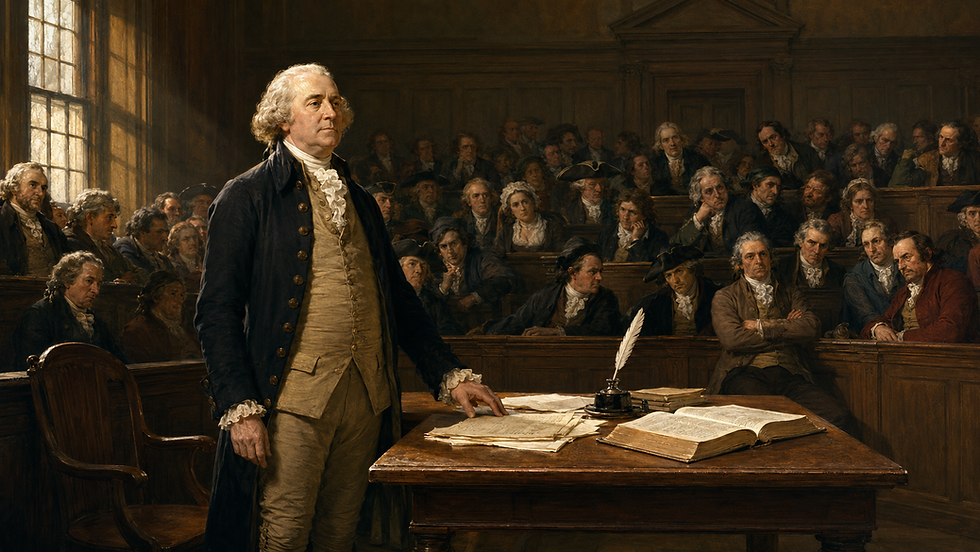
There is a kind of courage that draws a crowd. It marches beneath banners, speaks from platforms, and finds strength in the voices of others. It is visible, celebrated, and often contagious. But there is another kind of courage that emerges only after the crowd has gone home. It is quieter and more costly. It appears when applause has faded, when familiar voices have fallen silent, and when the person who once believed himself or herself surrounded discovers that conviction has left that person standing nearly alone.
The apostle Paul knew that loneliness. Near the end of his life, he stood before the authorities to answer for his faith. We do not know everything he hoped his friends might do for him, but we know what they did not do. “No one came to my support,” he wrote. “Everyone deserted me.” The words carry no trace of denial. Paul did not pretend that the absence of his companions was unimportant or that their desertion did not wound him. He stood in a place where friendship could have brought comfort and support, yet no friend appeared.
Still, Paul did not allow abandonment to become bitterness. “May it not be held against them,” he continued. Even in his loneliness, he refused to surrender his heart to resentment. The courage that enabled him to stand was not anger toward those who had left him. Neither was it confidence in his own strength. Paul endured because the absence of human support revealed the presence upon which he had always depended: “But the Lord stood at my side and gave me strength.”
Those words contain the secret of moral courage. Paul was left without human companionship, but he was not alone. The crowd had withdrawn, but Christ had not. His courage did not depend upon knowing that others would eventually approve of him. It came from knowing that faithfulness before God remained worthwhile, whatever the verdict of men might be.
It is easy to admire a courageous stand after history has vindicated it. It is far more difficult to take that stand before anyone knows how the story will end. Paul did not possess the comfort of reading the final chapter of his earthly life before living it. He stood because Christ was worthy of obedience, not because Paul had been promised an earthly escape from the consequences.
The courage to stand alone is not the desire to be different. Scripture does not celebrate stubbornness masquerading as conviction, nor does it teach that a person is righteous simply because he or she opposes the majority. A person may stand alone and still be wrong. Isolation does not make a belief righteous, any more than popularity makes it true. Moral courage begins with humility before God and submission to His truth. It does not ask merely, “What do I believe?” It asks, “What is right before God—and am I willing to obey Him even when obedience costs me something?”
Our culture often confuses courage with volume. The loudest voice is assumed to be the strongest, the angriest person the most committed, and the one who refuses all correction the most courageous. But genuine courage does not need to make a spectacle of itself. It may speak firmly, but it does not speak merely to be heard. It is willing to examine itself, listen carefully, and remain teachable. Its strength does not come from self-importance but from the conviction that truth is greater than the person defending it.
This kind of courage does not begin in Washington. It begins in the conscience—and the conscience must first learn to stand before God.
When Justice Becomes Unpopular
Long before John Adams helped shape the government of a new nation, he faced such a test in the streets and courtrooms of colonial Boston. The city was angry. Blood had been spilled. British soldiers had fired into a crowd, and five colonists lay dead. To many in Boston, the facts seemed obvious and the verdict already settled. The soldiers represented an occupying power increasingly viewed as hostile to colonial liberty. Defending them would invite suspicion, resentment, and possible injury to the reputation of anyone willing to accept the task.
Yet when the accused soldiers needed counsel, John Adams agreed to defend them.
Adams did not enter the courtroom without allies. Other attorneys joined the defense, witnesses came forward, and a jury would eventually weigh the evidence. Yet accepting the case required him to step apart from the passions of his community. Boston was his home. The colonial cause was his cause. The people demanding justice for the dead were his neighbors, friends, and future political allies. Nevertheless, Adams understood that sympathy for a cause could not be permitted to determine the guilt of an accused person.
The anger was understandable. The presence of British troops in Boston had already become an offense to colonists who believed their liberties were being steadily taken from them. The blood in the street appeared to confirm their worst fears. Paul Revere’s famous engraving presented the event as an orderly line of soldiers deliberately firing into a helpless crowd. It was powerful propaganda for the patriot cause—but a courtroom could not be governed by an engraving, public outrage, or political usefulness. It had to be governed by evidence.
He did not need to believe the soldiers were innocent before agreeing to represent them. He needed only to believe that guilt must be proven. This is one of the disciplines of a free society: justice must begin before we know whether we will approve of its conclusion. If due process is reserved only for people the public already favors, then it is not a principle. It is a privilege distributed by the crowd.
Adams did not ask the jury to forget the dead. He asked them to distinguish grief from proof and outrage from lawful judgment. In his closing argument, he reminded them that “facts are stubborn things.”⁴ Public wishes, political passions, and popular narratives could not change the evidence. The jury’s duty was not to satisfy Boston’s anger but to determine whether the prosecution had established the guilt of each defendant under the law.
Captain Preston was acquitted. Of the eight soldiers tried separately, six were found not guilty and two were convicted of manslaughter rather than murder.⁵ The verdicts did not declare that nothing terrible had happened. Five men were dead, families were grieving, and the conflict between Britain and the colonies remained unresolved. But the verdicts recognized that justice required careful distinctions. Responsibility had to be determined individually, evidence examined honestly, and punishment decided under law rather than by the emotional needs of the moment.
This was the courage of Adams’s stand. He refused to allow a worthy cause to excuse an unworthy method.
The cause of American liberty did not need falsehood to sustain it. If the rights of the colonists were truly rooted in a moral order higher than the will of rulers, then those same rights had to be extended to unpopular defendants. The colonists could not credibly protest arbitrary British power while exercising arbitrary power over British soldiers. Liberty could not be defended by abandoning justice, for justice was part of the very liberty they claimed.
This is where moral courage becomes more demanding than political loyalty. Political loyalty asks, “Whose side are you on?” Moral courage asks, “What is true?” Political passion divides the world into friends who must be defended and enemies who must be condemned. Justice recognizes that a friend may be wrong and an enemy may still possess rights. It insists that truth does not change uniforms when it crosses the street.
Scripture speaks directly to this danger. The law of Moses commanded Israel, “Do not follow the crowd in doing wrong.”⁶ The warning does not assume that the crowd will always be wrong. It recognizes that numbers cannot relieve a person of moral responsibility. We do not become innocent of wrongdoing merely because many others joined us. Neither popularity nor pressure changes the character of an unjust act.
Courage Is Not Defiance
In such an atmosphere, defiance can easily be mistaken for courage. The person who speaks most harshly is praised for boldness. The one who refuses to listen is admired for refusing to compromise. Cruelty is excused as honesty, and humiliation is defended as necessary because the issue is important. Yet the importance of truth does not give us permission to abandon the character of the One who is truth.
The apostle Peter instructed believers to be prepared to give a reason for the hope within them, but he immediately added, “Do this with gentleness and respect, keeping a clear conscience.”⁷ Scripture joins conviction and character together. Christians are not merely responsible for defending what is true; we are responsible for the spirit in which we defend it. Gentleness does not make truth weaker. Respect does not require surrender. A clear conscience demands that both our message and our manner remain faithful to Christ.
This is the difference between courage and defiance. Defiance is often driven by the need to prove oneself strong. Courage is willing to appear weak rather than become unfaithful. Defiance feeds upon anger and requires an adversary.
Courage draws its strength from conviction and remains steady whether anyone is watching or not.
Defiance says, “No one will tell me what to do.” Courage says, “I must obey God, whatever others may do.”
Our culture desperately needs that kind of courage. We need citizens who can oppose an idea without despising the person who holds it, Christians who can defend moral truth without delighting in another person’s humiliation, and leaders who can admit inconvenient facts without fearing that honesty will be interpreted as betrayal. We need people whose principles are strong enough to survive contact with complexity.
When that happens, conscience is no longer governed; it is recruited.
This danger exists across the political spectrum. No party is immune to human nature, and no movement should be trusted with the place in our hearts that belongs to God alone. Christians may participate vigorously in political life, advocate for righteous laws, and oppose destructive ideas. But they must never surrender conscience to a party, candidate, or cause. Their first allegiance is to Christ, and that allegiance gives them both the courage to confront opponents and the freedom to correct friends.
If our friends must never be questioned, they have become our masters. If our cause must never be examined, it has become our idol. And if truth may be set aside whenever it threatens our belonging, then belonging has become more precious to us than faithfulness.
When Standing Becomes Costly
Most of us will never stand before a royal governor, defend accused soldiers in a trial that captures the attention of a colony, or answer for our faith before an imperial court. Yet the moral decisions faced by John Adams and the apostle Paul are not confined to history. The circumstances change, but the question remains. Every generation must decide whether truth is worth the cost of standing for it.
In that moment, the temptation is rarely to renounce everything we believe. It is simply to remain quiet.
But there is another kind of silence—the silence that knows truth should be spoken and refuses because the price appears too high. It disguises itself as prudence, yet beneath it lies fear: fear of rejection, misunderstanding, lost influence, or the discovery that we have depended too greatly upon the approval of others.
Citizens face the test whenever political loyalty asks them to excuse what they would condemn in the opposing party. If honesty matters only when an opponent lies, it does not truly govern us. If character matters only when the other party’s candidate lacks it, then character has become a campaign instrument rather than a conviction.
Courageous citizens apply the same moral measure to friend and adversary because truth cannot preserve a republic once it has been made subordinate to victory.
Yet repentance for speaking wrongly must not become an excuse for refusing to speak at all. The world does not need a church that is merely less offensive than it once was. It needs a church that is more faithful—more truthful, compassionate, holy, courageous, and clearly formed by Jesus. Our manner should become gentler even as our convictions become deeper. Grace should make us less cruel, not less clear.
Great courage is usually built from smaller obediences. Every time we honor truth when a lie would benefit us, speak when fear urges silence, or remain gracious when anger offers power, the soul is being prepared to stand. Jesus taught that faithfulness in little things reveals whether we can be trusted with greater things.⁸ The unnoticed decisions matter. Courage is not merely an action taken during a crisis; it is a character cultivated before the crisis arrives.
The future of liberty is therefore being shaped in places that will never appear in a history book: around dinner tables, inside classrooms, behind church doors, in workplace conversations, and within the private chambers of conscience. It is being shaped whenever an ordinary person decides whether to follow the crowd in doing wrong or remain faithful when faithfulness has become uncomfortable.
The Lord Stood at My Side
The courage to stand alone does not begin with confidence that we are stronger than everyone around us. It begins with the recognition that we are not sufficient in ourselves. If courage depended upon natural fearlessness, it would belong only to a rare class of people. But biblical courage is not the absence of fear. It is faithfulness sustained by the presence of God.
Paul did not write, “Everyone deserted me, but I discovered that I was strong enough.” He wrote, “But the Lord stood at my side and gave me strength.” His confidence was not in the greatness of his own character. The strength that enabled him to remain faithful came from beyond himself.
The presence of Christ protects courage from becoming self-righteousness. When we remember that our strength comes from Him, we have no reason to boast. When we remember how patiently He has dealt with our failures, we have no permission to despise those who struggle. We may need to stand apart from others without placing ourselves above them.
This is the kind of courage capable of healing a divided nation. It does not abandon conviction for the sake of an artificial peace, but neither does it make reconciliation impossible through contempt. It stands for truth while leaving the door open for repentance, restoration, and renewed fellowship. It does not need an opponent to remain permanently condemned in order to feel permanently vindicated.
America does not merely need more people willing to oppose one another. We have already mastered opposition. We need citizens whose consciences are sufficiently grounded to resist both the intimidation of enemies and the seduction of friends. We need people capable of standing apart from the crowd without hating the crowd, correcting their own side without joining the other, and speaking unpopular truths without delighting in the pain those truths may cause.
But faithfulness is not measured solely by visible results.
John Adams could not know, when he accepted the defense of the British soldiers, how history would remember his decision. Paul could not know, when no one appeared at his defense, how many generations would draw strength from his testimony. Each man acted within the responsibility God had placed before him. The consequences belonged to the future; the decision to be faithful belonged to that moment.
So it is with us. We often hesitate because we want assurance that our stand will succeed. We want to know that others will eventually agree, that our reputation will be restored, or that the sacrifice will produce a result large enough to justify the cost. Yet obedience does not always come with such guarantees. Sometimes we must do what is right simply because it is right before God.
Perhaps the moment will come within a conversation where everyone expects your agreement. Perhaps it will arise when someone is being treated unjustly and defending that person could make you unpopular. It may come when your profession asks for an affirmation your conscience cannot give, when your political allies excuse conduct you know is wrong, or when your church is tempted to exchange truth for acceptance. It may enter your home when love requires a boundary that will not be immediately understood.
No one else can make that decision for you. The crowd may encourage faithfulness, but it cannot supply conviction. Friends may strengthen your resolve, but they cannot obey in your place. At the decisive moment, every person stands within his or her own conscience before God.
This is why the renewal of a nation must finally become personal. We may rightly pray for courageous leaders, faithful pastors, principled judges, honest journalists, wise teachers, and steadfast parents. But those prayers must eventually become a willingness to embody the qualities we ask God to place in others.
A republic cannot be kept by spectators who admire courage from a safe distance. Liberty survives when ordinary citizens become trustworthy enough to bear its responsibilities. That trustworthiness is formed whenever a man or woman chooses truth over approval, justice over tribal loyalty, obedience over convenience, and grace over resentment.
The courage to stand alone does not mean that we should seek isolation. God created us for fellowship, placed us within the church, and instructed believers to encourage one another. We should stand together whenever we can. We should strengthen those whose convictions have made them weary and refuse to leave faithful people unnecessarily alone.
Yet our willingness to stand together will mean little if none of us is willing to stand first.
Someone must speak before the room changes. Someone must refuse before others discover that refusal is possible. Someone must tell the truth before the approved falsehood begins to lose its power. Courage is often contagious, but it becomes contagious only after one person accepts the possibility of standing without company.
Perhaps that person will be you.
You may feel your limitations. Courage does not require pretending those weaknesses are absent. It requires bringing them honestly before the One who stood beside Paul. The Lord has not changed. He remains near to those who seek to obey Him. His presence does not guarantee that every earthly outcome will be pleasant, but it assures us that no faithful stand is taken alone.
The crowd may withdraw. Friends may hesitate. Institutions may punish what they once praised, and the culture may condemn what it once understood. But the verdict of the crowd is not the final measure of a faithful life.
Paul’s testimony still reaches across the centuries: “The Lord stood at my side and gave me strength.” The same Lord stands with His people now. The question is whether we will trust Him enough to stand.
Will I stand when standing becomes costly?
Spirit & Truth,
Thom H. Paine
Notes
2 Timothy 1:12 NIV.
National Park Service, “Boston Massacre Site,” updated January 24, 2025, https://www.nps.gov/places/boston-massacre-site.htm.
National Park Service, “Boston Massacre Trial,” updated February 23, 2026, https://www.nps.gov/articles/000/boston-massacre-trial.htm.
John Adams, closing argument in Rex v. Wemms et al., December 1770, in Legal Papers of John Adams, vol. 3, ed. L. Kinvin Wroth and Hiller B. Zobel (Cambridge, MA: Belknap Press of Harvard University Press, 1965), 269.
Massachusetts Historical Society, “Perspectives on the Boston Massacre: The Trials,” accessed July 20, 2026, https://www.masshist.org/features/massacre/trials.
Exodus 23:2 NIV.
1 Peter 3:15–16 NIV.
Luke 16:10 NIV.
The Founders’ Quill seeks to recover the spiritual and moral foundations that shaped the American experiment in ordered liberty. By returning to Scripture, history, and the wisdom of those who came before us, we are invited not merely to admire our inheritance but to become people capable of preserving it.


Comments