

The Work Is Now Ours: Christian citizenship and ordered liberty

The Christian Citizen’s Commission to Keep the Republic
A Weekly Devotional from The Founders’ Quill: Reclaiming America’s Judeo-Christian Heritage through Spirit and Truth.

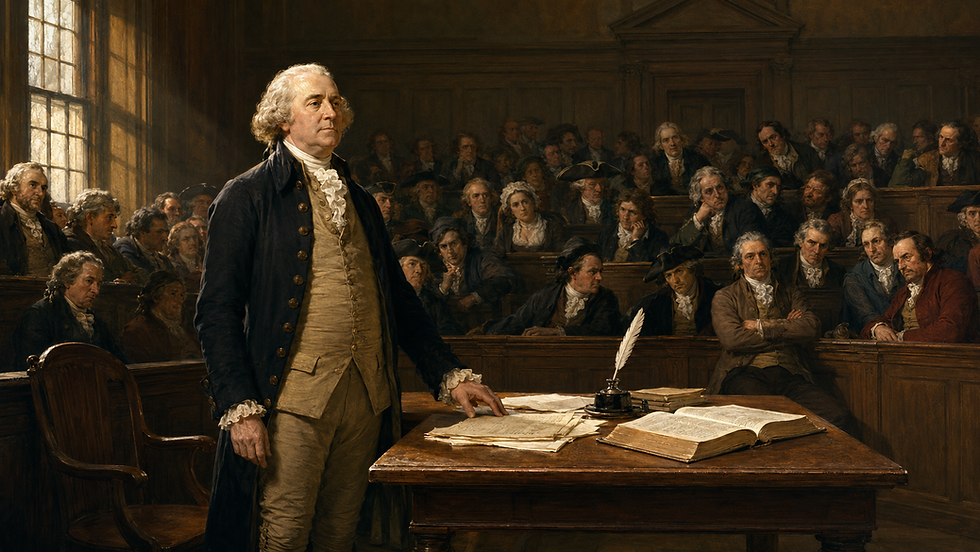
On December 23, 1783, George Washington entered the chamber of the Maryland State House in Annapolis carrying a single sheet of paper. The war for independence had ended. The Treaty of Paris had been signed. British troops had withdrawn from New York, and the commander in chief of the Continental Army had said farewell to the officers who had shared the long struggle with him.
Now Washington stood before the Continental Congress to surrender the power that had been entrusted to him. The room was crowded. Members of Congress remained seated and covered, according to the custom of the day, while Washington stood before them in uniform. His voice reportedly trembled with emotion as he acknowledged the officers and soldiers who had served beside him. Then he came to the purpose for which he had entered the chamber:
“Having now finished the work assigned me,” Washington declared, “I here offer my Commission, and take my leave of all the employments of public life.”¹
With those words, Washington relinquished command of the army and returned power to civilian authority. He bowed to Congress and left the chamber. Within days, he was home at Mount Vernon.
The victorious general did not seize the government he had helped create. He did not use the loyalty of his soldiers to secure a crown. He did not claim that the sacrifices of the war entitled him to permanent power. He completed the work entrusted to him and laid his authority down.
That moment revealed something essential about the character required for liberty. The American Revolution had not been fought merely to replace one ruler with another. It had been fought so that a free people might govern themselves under laws rather than live at the mercy of those who possessed power.
Washington could surrender his commission because the work of the army was ending. But another commission was beginning.
The work of preserving the republic now belonged to its citizens.
An Inheritance Placed in Our Hands
At the beginning of this journey, we stood with Benjamin Franklin outside the Constitutional Convention and heard the warning that has followed the American experiment from its birth: “A republic, if you can keep it.”²
Franklin understood that a constitution could establish the structures of republican government, but it could not create the character necessary to sustain them. Laws could restrain some expressions of evil, but they could not make a people virtuous. Elections could transfer political authority, but they could not teach citizens to exercise that authority wisely. Institutions could distribute power, but they could not compel those who held power to surrender it when their time was finished.
The Founders could declare independence. They could defeat an army. They could frame a Constitution. They could establish institutions of ordered liberty. But they could not preserve the republic for us.
No generation can do that for the generation that follows. Each receives an inheritance it did not create, enjoys freedoms purchased by sacrifices it did not make, and then faces the question of whether it will faithfully pass those blessings onward.
We are accustomed to speaking of our rights. We are less accustomed to speaking of our stewardship. Yet every right we possess carries a responsibility. Freedom of speech requires a people committed to truth. Religious liberty requires believers willing to practice their faith openly and defend the conscience of others. The right to vote requires citizens capable of judgment rather than manipulation. Parental rights require parents willing to form their children. Limited government requires men and women capable of governing themselves.
Liberty is not merely something we possess. It is something entrusted to us.
The question before us, therefore, is not only, “What freedoms have I inherited?” It is also, “What am I doing with the liberty placed in my hands?”
The Commission of Salt and Light
Jesus did not instruct His followers to retreat from a darkening world. Nor did He commission them to conquer it through coercion. He gave them a different calling:
“You are the salt of the earth.… You are the light of the world.”—Matthew 5:13–14, NIV
Salt preserves what would otherwise decay. Light reveals what darkness conceals. Salt must come into contact with what it preserves, and light must shine where it can be seen. Neither can fulfill its purpose while remaining safely removed from the world around it.
Christians are sometimes tempted toward one of two errors in public life. Some withdraw almost entirely, treating faith as a private matter that should remain confined to the home and the church. Others begin to place their hope in political strength, imagining that righteousness can be imposed through the acquisition of enough cultural power. Neither reflects the way of Christ.
The believer’s commission is not withdrawal, and it is not domination. It is faithful presence.
We are called to speak truth without cruelty, exercise courage without arrogance, defend conviction without hatred, and serve our neighbors without demanding that they first agree with us. We enter public life not to make an idol of politics but to bear witness to a kingdom that stands above every political party, ideology, and nation.
Salt does not preserve by becoming identical to the substance around it. Light does not overcome darkness by dimming itself enough to avoid offense. Christian witness requires a holy distinctiveness—a people whose lives reveal another way of being human.
When our society treats truth as a personal preference, we must live as people who believe truth can be known. When marriage and family are weakened, we must build homes marked by covenant, fidelity, sacrifice, and love. When human dignity is determined by usefulness, strength, age, or wantedness, we must defend the worth of every person created in the image of God. When public conversation descends into contempt, we must demonstrate conviction joined with grace.
The world does not need Christians who merely win arguments. It needs Christians whose lives make the truth believable.
Liberty Must Be Lived Before It Can Be Defended
There is a temptation to imagine that America’s moral and cultural crisis exists somewhere beyond us. We locate it in Washington, in the courts, in the schools, in the media, or in the behavior of people whose convictions differ from our own.
Those concerns are not imaginary. Institutions matter. Laws shape culture, schools form minds, and government can either protect or violate the freedoms God has given. Faithful citizens must remain informed and engaged.
But a republic rarely loses its character first in the halls of government. It loses its character in the habits of its people.
A nation becomes dishonest because individuals become comfortable with dishonesty. Families weaken because husbands and wives cease to honor their covenants. Children become morally unmoored because adults surrender the responsibility of formation. Public debate becomes cruel because citizens decide that contempt is easier than persuasion. Government expands beyond its proper limits because people increasingly demand that political power solve problems that character, family, church, and community have neglected.
We cannot preserve in law what we refuse to practice in life.
The defense of marriage begins with the keeping of our own vows. The defense of truth begins with refusing to speak falsely when a lie would be convenient. The defense of religious liberty begins with actually exercising our faith. The defense of the family begins at our tables, in our priorities, and in the time we give our children. The defense of human dignity begins in the way we treat the vulnerable person already before us.
This is where the commission becomes personal.
We may denounce the corruption of public officials while excusing bitterness, greed, lust, or dishonesty in ourselves. We may lament what children are being taught while neglecting to teach them the Scriptures, the story of their country, or the virtues necessary for freedom. We may pray for national revival while resisting the repentance through which revival must begin.
The republic cannot be morally stronger than the people who compose it.
Before asking whether America will return to God, each of us must ask whether we have returned to Him.
The Republic Is Kept Close to Home
The work of preserving liberty often appears less dramatic than the work of winning it. Most of us will never stand before Congress and surrender a military commission. We will not sign a Declaration of Independence or participate in a constitutional convention.
Our commission will ordinarily be carried out in quieter places.
The republic is kept when parents teach their children that freedom does not mean doing whatever they desire, but possessing the moral strength to do what is right.
It is kept when pastors proclaim the whole counsel of God without reshaping truth to satisfy the spirit of the age.
It is kept when teachers form students to pursue wisdom rather than merely credentials.
It is kept when citizens attend local meetings, serve on school boards, assist their neighbors, support worthy institutions, and accept responsibility for the communities in which God has placed them.
It is kept when employers treat workers justly, when workers labor honestly, when business owners refuse corrupt gain, and when public servants remember that authority is a trust rather than a possession.
It is kept when Christians defend the religious liberty of their neighbors as conscientiously as they defend their own, because conscience cannot remain a sacred right if it is protected only for those with whom we agree.
It is kept whenever an ordinary person chooses courage over convenience, duty over appetite, truth over acceptance, and service over self-interest.
These actions rarely make headlines. Yet a free society depends upon them far more than it depends upon the speeches of politicians. The daily practices of faithful citizens become the hidden architecture of ordered liberty.
Scripture instructs us:
“Do not be overcome by evil, but overcome evil with good.”—Romans 12:21, NIV
That is not a call to passivity. It is a commission to resist evil without becoming shaped by it. If we answer hatred with hatred, deception with deception, or coercion with coercion, we may defeat an opponent while surrendering the character necessary to remain free.
Christian citizens must therefore ask not only whether our cause is right, but whether our conduct reflects Christ.
The Strength to Surrender Power
Washington’s resignation confronts our age because we live in a culture that teaches people to acquire power, display power, and retain power. Public life increasingly treats compromise as weakness, humility as irrelevance, and opponents as enemies who must be destroyed.
Yet one of the most decisive acts in Washington’s public life was not the exercise of power but its surrender.
Self-government requires this kind of restraint at every level. Presidents must leave office. Legislators must remain subject to the laws they enact. Judges must recognize the limits of their authority. Pastors must remember that the church belongs to Christ. Parents must exercise authority for the good of their children rather than for the satisfaction of their own desires. Citizens must sometimes lay aside personal advantage for the sake of the common good.
Power is safest in the hands of those who know it is temporary, accountable, and entrusted by God.
Washington was not a perfect man, and historical faithfulness does not require us to pretend otherwise. Like the nation he helped establish, his life contained contradictions that deserve honest examination. But neither wisdom nor justice is served by refusing to learn from the virtues he did demonstrate. In Annapolis, Washington gave the young republic an example of restraint that rulers throughout history have often failed to follow.
He demonstrated that character matters most when a person possesses the power to act otherwise.
The same is true for us. Character is revealed when we could deceive but choose truth, when we could retaliate but choose restraint, when we could exploit another’s weakness but choose mercy, and when we could place ourselves first but choose to serve.
A republic cannot be preserved by citizens who demand virtue from their leaders while exempting themselves from its obligations.
A Commission, Not a Political Idol
The Christian’s concern for the nation must always remain beneath the Christian’s allegiance to Christ.
America is not the kingdom of God. No political party is the church. No election can accomplish the new birth, no government program can produce holiness, and no national revival can occur apart from repentance and the transforming grace of God.
This does not make political participation unimportant. It places it in its proper order.
We engage in public life because loving our neighbor includes concern for the laws, institutions, and cultural conditions under which our neighbor lives. We defend liberty because human beings bear the image of God. We protect conscience because faith cannot be coerced. We seek justice because God loves righteousness. We preserve the family because it is the first school of love, responsibility, sacrifice, and belonging.
But we do not place our hope in political power.
The moment Christians believe that winning control is more important than remaining faithful, politics has become an idol. When we excuse dishonesty because it advances our cause, overlook corruption because it benefits our side, or treat another human being as beyond the reach of grace, we have ceased to defend the moral foundation of liberty. We have begun to undermine it.
Christ calls us to a more demanding path: conviction without cruelty, courage without pride, engagement without idolatry, and hope that remains anchored in God rather than in the fortunes of a nation.
We are citizens of an eternal kingdom. Precisely because of that higher citizenship, we should become more faithful stewards of the earthly communities entrusted to us.
The Work Is Now Ours
More than two centuries separate us from the day Washington surrendered his commission. The crowded chamber has grown quiet. The delegates have departed. The general has returned home.
But the commission has passed from one generation to another.
It has now come to us.
We did not create the principles upon which ordered liberty rests. We did not write the Declaration, frame the Constitution, endure the winter at Valley Forge, fight to end slavery, march for civil rights, or bear every sacrifice through which the American promise was more fully extended.
But we have inherited the fruit of those struggles.
The question is whether we will consume that inheritance or preserve it.
Will we form children capable of freedom? Will we defend truth when falsehood is more fashionable? Will we practice the faith we claim to value? Will we stand for conscience when standing becomes costly? Will we serve our neighbors, strengthen our communities, and accept the duties that accompany our rights? Will we seek the good of the nation without placing the nation in the place of God?
Franklin’s challenge still stands: “A republic, if you can keep it.”
The answer will not finally be supplied by a president, a Congress, a court, or an election. It will be supplied in the lives of ordinary citizens. It will be answered in our homes, churches, schools, workplaces, communities, and daily choices.
Washington could say that he had finished the work assigned to him.
We cannot yet say the same.
Our work is before us.
Jesus has called us to be salt and light. History has placed an inheritance in our hands. Those who come after us will live with what we preserve, what we neglect, and what we surrender.
The Founders established the republic, but they could not keep it for us.
The work is now ours.
Spirit & Truth,
Thom H. Paine
Notes
George Washington, “Address to Congress on Resigning His Commission,” December 23, 1783, George Washington Papers, Manuscript Division, Library of Congress, Washington, DC.
James McHenry, diary entry, September 18, 1787, in The Records of the Federal Convention of 1787, ed. Max Farrand, vol. 3 (New Haven, CT: Yale University Press, 1911), 85.
Bibliography
McHenry, James. Diary Entry. September 18, 1787. In The Records of the Federal Convention of 1787. Edited by Max Farrand. Vol. 3. New Haven, CT: Yale University Press, 1911.
The Holy Bible, New International Version. Grand Rapids, MI: Zondervan, 2011.
United States House of Representatives. “General George Washington Resigned His Commission in Annapolis, Maryland.” History, Art & Archives. Accessed August 10, 2026.
Washington, George. “Address to Congress on Resigning His Commission.” December 23, 1783. George Washington Papers. Manuscript Division, Library of Congress, Washington, DC.
*The Founders’ Quill seeks to recover the spiritual and moral foundations that shaped the American experiment in ordered liberty. By returning to Scripture, history, and the wisdom of those who came before us, we are invited not merely to admire our inheritance but to become people capable of preserving it.


Comments