

The Discipline of Liberty: True Liberty Requires the Strength to Govern What Would Otherwise Govern Us

True Liberty Requires the Strength to Govern What Would Otherwise Govern Us
A Weekly Devotional from The Founders' Quill: Reclaiming America's Judeo-Christian Heritage through Spirit and Truth.
“I have the right to do anything,” you say—but not everything is beneficial. “I have the right to do anything”—but I will not be mastered by anything.—1 Corinthians 6:12 (NIV)
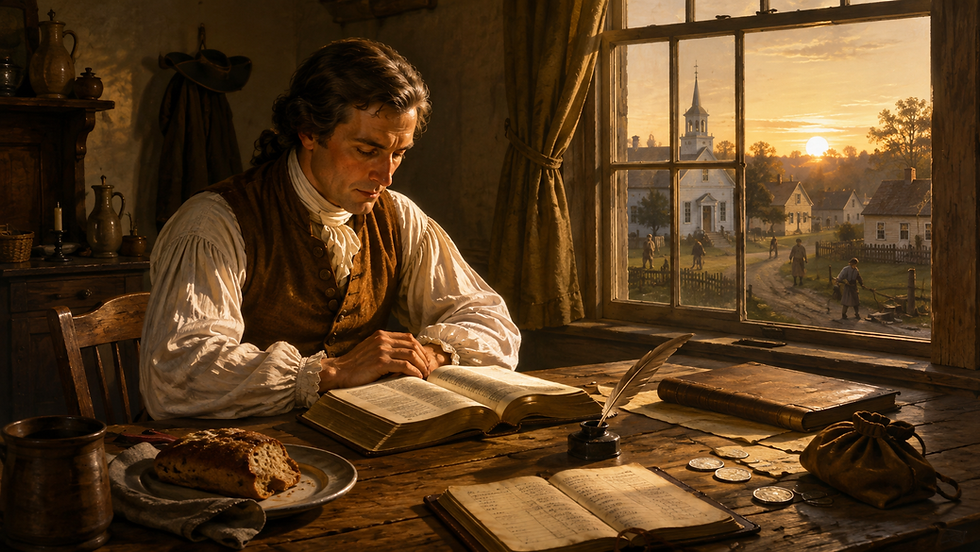
The Discipline of Liberty
There is a peculiar contradiction at the heart of modern American life. We speak constantly of freedom while becoming increasingly enslaved. We possess freedoms our ancestors could scarcely have imagined. We can travel enormous distances in hours, communicate across the world in seconds, purchase almost anything without leaving our homes, summon entertainment whenever we desire it, and arrange much of life according to personal preference. The modern person enjoys an astonishing degree of choice.
Yet many of us cannot sit quietly for ten minutes without reaching for a phone. We cannot hear an opinion we dislike without becoming angry. We cannot pass an advertisement without feeling that we need something more. We struggle to control what we eat, what we watch, what we spend, what we say, and what occupies our thoughts. Some are mastered by alcohol or drugs, others by pornography, ambition, possessions, entertainment, political outrage, approval, resentment, or the endless appetite for something new.
We have multiplied our choices while diminishing our capacity to govern them. That ought to trouble a people who call themselves free.
Freedom Is Not the Absence of Restraint
Our age has largely come to define freedom as the removal of restraint. If I desire something, freedom means being permitted to pursue it. If some tradition, institution, moral teaching, religious conviction, or social expectation tells me that I should restrain that desire, then the restraint itself is increasingly regarded as oppressive.
But this understanding of liberty would have seemed dangerously incomplete to earlier generations of Americans. Benjamin Franklin expressed the older understanding with characteristic simplicity when he wrote in 1787, “Only a virtuous people are capable of freedom. As nations become corrupt and vicious, they have more need of masters.”¹ The opposite of virtue, in Franklin's reasoning, was not merely bad behavior. Its eventual consequence was the loss of freedom.
Someone must govern human appetite. Either we learn to govern ourselves, or eventually something outside ourselves will have to do it for us. That was one of the assumptions beneath the American experiment in self-government. A republic could entrust extraordinary liberty to ordinary citizens only if those citizens possessed sufficient character to restrain themselves when no magistrate was standing nearby.
This is why the Founders spoke so frequently about virtue. They were not suggesting that government should make everyone righteous. They understood something much more basic: limited government requires people capable of self-limitation. A population that cannot govern its appetites will eventually demand that someone else manage the consequences.
“I Will Not Be Mastered”
Long before the American republic, the apostle Paul expressed the principle in language even more personal. “I have the right to do anything,” the Corinthians were saying. Paul did not answer merely by producing a longer list of prohibitions. Instead, he asked them to consider what their supposed freedoms were doing to them: “I will not be mastered by anything.”
There is the test. Not simply, Am I permitted to do this? but What is this doing to me? Can I put it down? Can I walk away? Can I say no? Can I hear my appetite demanding satisfaction and answer, “You are not my master”?
That is a far more searching definition of liberty. The man who cannot control his anger is not free merely because the First Amendment protects his speech. The woman who cannot stop spending is not free merely because the marketplace offers unlimited choices. The teenager who cannot put down a phone is not free merely because no parent has taken it away. The adult who cannot resist sexual temptation is not free merely because society has declared the behavior acceptable. And the citizen who spends hour after hour feeding on political outrage is not necessarily defending liberty; he may have surrendered his peace, judgment, charity, and attention to people whose livelihood depends upon keeping him angry.
A chain does not cease to be a chain because we chose it ourselves.
The Forgotten Discipline of Saying No
This is where our Judeo-Christian inheritance speaks with uncomfortable clarity. Scripture never assumes that every human desire should be obeyed. Quite the opposite. The Bible treats the human person with enormous dignity because we are created in the image of God, but it also treats human appetite with sober realism because we are fallen creatures. Our desires are not always trustworthy. Our hearts require formation, our appetites require boundaries, and our passions must be ordered toward what is good.
That is why Scripture speaks so often about self-control. Paul lists self-control among the fruit of the Spirit.² Peter tells believers to add self-control to their knowledge.³ Proverbs warns that “like a city whose walls are broken through is a person who lacks self-control.”⁴ The image is striking because an ancient city without walls was not liberated; it was defenseless. Anything could enter, and anything could conquer it. So it is with a human life without moral boundaries.
Our culture has taught us to regard boundaries primarily as restrictions upon freedom. Scripture teaches us to see righteous boundaries as guardians of freedom. Sometimes the most liberating word a human being can learn is no: no, I do not need to buy it; no, I will not watch it; no, I will not allow anger to decide how I treat this person; no, I will not permit desire to redefine what is true; no, I will not surrender another evening to a glowing screen while the people God has entrusted to me sit in the same room.
This is not repression. It is government of the self.
Discipline Has a Destination
But Christian discipline cannot end with saying no. Otherwise Christianity becomes little more than a collection of restrictions, and virtue becomes grim moral bookkeeping. The purpose of self-control is not simply to make us better at denying ourselves. It is to make us available for something better.
Paul used the image of an athlete: “Everyone who competes in the games goes into strict training.... I strike a blow to my body and make it my slave.”⁵ An athlete accepts discipline because he has somewhere he intends to go. He gets up when he would rather sleep, trains when he would rather rest, refuses some foods and chooses others, and repeats difficult exercises when comfort would be easier. From the outside, his life may appear restricted, but those restrictions are producing a greater freedom. He is becoming capable of doing what an undisciplined person cannot do.
The same principle governs the spiritual life. We discipline our tongues so that we become free to speak words that give life. We discipline our spending so that we become free to give. We discipline our appetites so that we become free to serve. We discipline our schedules so that we become free to attend to the people who matter. We discipline our thoughts so that we become free to recognize truth, and we discipline our desires so that we become free to obey God.
Self-control is not the enemy of liberty. It is one of liberty's necessary conditions.
A Republic of Appetites Cannot Remain Free
The Founders understood that what is true of an individual eventually becomes true of a nation. Samuel Adams warned that when “knowledge is diffused and Virtue is preserved,” a people are difficult to subdue. But when people become ignorant and corrupted in their manners, he warned, “they will sink under their own weight without the Aid of foreign Invaders.”⁶ There is common sense in that warning. A nation need not always be conquered from outside; it can lose the capacity for liberty from within.
Imagine a society in which citizens increasingly cannot govern their appetites, families cannot remain intact, debts cannot be restrained, children cannot be disciplined, anger cannot be moderated, sexuality cannot be bounded, consumption cannot be satisfied, and personal responsibility is continually transferred elsewhere. The consequences do not simply disappear. Someone must deal with them.
More institutions intervene. More regulations appear. More bureaucracies develop. More responsibilities once carried by individuals, families, churches, neighborhoods, and voluntary associations migrate toward distant authorities. Not every government program is tyranny, nor is every regulation an assault upon liberty. Civil government has legitimate and necessary responsibilities. But the underlying principle remains: as self-government decreases, external government tends to increase.
Franklin's warning deserves to be heard again. A people who lose virtue eventually “have more need of masters.” The road toward dependency is often paved not by someone first taking our freedom from us, but by our gradually surrendering the habits necessary to exercise it.
Before We Blame Washington
This is where the argument becomes uncomfortable. It is easy to blame politicians, universities, Hollywood, corporations, activists, the media, political parties, or cultural elites. Sometimes blame is deserved. But Chapter 27 brought us to a harder truth: a republic ultimately rests upon the governed self.
So before we ask what Washington is doing, perhaps we should ask what is happening in our own homes. Before demanding fiscal discipline from Congress, do we practice it ourselves? Before condemning dishonesty among public officials, are we truthful when dishonesty would benefit us? Before lamenting the breakdown of the family, are we faithfully tending our marriages, children, parents, and commitments? Before complaining that young people lack discipline, what do they see when they watch us?
And before denouncing cultural addiction, what can we not put down? Before demanding courage from leaders, where have we remained silent because speaking truth might cost us something? A republic is not an abstraction. It is millions of individual lives lived together, and the character of those lives eventually becomes the character of the country.
The Question in the Mirror
There is therefore a question worth carrying into prayer this week:
What has mastered me?
We should not answer too quickly, because the most powerful masters are often the ones we have stopped recognizing as masters. Perhaps it is the phone, food, alcohol, pornography, work, money, resentment toward someone who wounded us years ago, the need to be admired, fear, comfort, or politics. Perhaps it is simply the insistence that nobody—not Scripture, not tradition, not family, not church, and not God Himself—has the right to tell us no.
Whatever it is, Christian liberty begins when we can bring that appetite before Christ and say, You will not be my master. We say this not because we possess heroic willpower and not because disciplined people earn God's favor, but because the Christian already has a Master. Jesus Christ does not free us so that we may exchange one bondage for another. He frees us to become what we were created to be.
Paul told the Galatians, “It is for freedom that Christ has set us free.”⁷ Only a few verses later he explains what that freedom means: “Do not use your freedom to indulge the flesh; rather, serve one another humbly in love.”⁸ There is the Christian paradox. We become free not when we are finally permitted to serve ourselves without restraint, but when grace releases us from the tyranny of self so that we are capable of loving God and neighbor.
A People Capable of Liberty
Perhaps we have spent too much time asking how we can preserve our freedoms and too little time asking whether we are becoming people capable of possessing them.
The Constitution can restrain government. Laws can protect rights. Courts can defend liberties. Elections can remove bad leaders. But none of these can create character. That work happens elsewhere—in homes, churches, friendships, habits, decisions, and those quiet moments when no one else is watching.
It happens when a father turns off the television and listens to his child, when a husband or wife keeps a promise that has become difficult to keep, and when a young person closes a screen because what is appearing there is corrupting the soul. It happens when someone chooses generosity over another purchase, when a Christian refuses to repeat a rumor even though it helps his political side, and when we forgive, tell the truth, keep our word, pray instead of rage, worship instead of consume, and choose the good when no one is watching.
These acts will never make the evening news, but republics are built from them. So are souls.
America does not first need more people demanding their liberty. America needs more people capable of carrying it.
The restoration of ordered liberty will not begin in Washington. It will begin wherever an ordinary man or woman stands before an appetite, temptation, resentment, fear, or desire and quietly declares, I will not be mastered.
That is discipline. That is self-government. And that is where liberty begins.
Spirit & Truth,
Thom H. Paine
Notes
Benjamin Franklin to the Abbés Chalut and Arnaud, April 17, 1787.
Galatians 5:22–23.
2 Peter 1:5–6.
Proverbs 25:28 (NIV).
1 Corinthians 9:25, 27 (NIV).
Samuel Adams to James Warren, November 4, 1775.
Galatians 5:1 (NIV).
Galatians 5:13 (NIV).
Bibliography
Adams, Samuel. Letter to James Warren. November 4, 1775.
Franklin, Benjamin. Letter to the Abbés Chalut and Arnaud. April 17, 1787.
The Holy Bible, New International Version. Grand Rapids, MI: Zondervan.
The Founders’ Quill seeks to recover the spiritual and moral foundations that shaped the American experiment in ordered liberty. By returning to Scripture, history, and the wisdom of those who came before us, we are invited not merely to admire our inheritance but to become people capable of preserving it.


Comments