

The Responsibility to Know: A Free People Must Be a Discerning People

A Weekly Devotional from The Founders' Quill: Reclaiming America's Judeo-Christian Heritage through Spirit and Truth.

Christian discernment and truth
There was a time when obtaining information required considerable effort. News traveled slowly. Letters took days or weeks to arrive. Newspapers had to be printed, carried, purchased, and read. A person living in one part of the country might know relatively little about events unfolding somewhere else until long after they had occurred.
Our problem is almost exactly the opposite. Information now arrives faster than we can possibly absorb it. Before breakfast we can know what a politician said in Washington, what happened overnight in Europe, what frightened financial markets in Asia, what controversy erupted in a city we have never visited, and what thousands of people we have never met think about all of it. The scarcity is no longer information. The scarcity is attention, patience, and discernment.
Last week we considered the responsibility of the citizen. We said that having an opinion about the republic is not the same thing as taking responsibility for it. Responsible citizenship requires us to learn before speaking, to distinguish verified information from rumor, and to think carefully enough that we are not merely repeating what someone else has told us to believe.
That raises a more difficult question.
Do I want to know what is true—or do I simply want to be told that what I think is true?
That question reaches much deeper than newspapers, television networks, websites, social media, political parties, or government officials. All of those can mislead us. All deserve appropriate scrutiny. But if we stop there, we have once again found a way to put the problem somewhere outside ourselves.
The harder question is why falsehood sometimes finds such a welcoming place within us.
The First Story Always Sounds Convincing
The book of Proverbs understood the problem long before anyone imagined twenty-four-hour news or social media. “To answer before listening—that is folly and shame” (Proverbs 18:13 NIV). Only a few verses later comes another remarkably practical observation: “In a lawsuit the first to speak seems right, until someone comes forward and cross-examines” (Proverbs 18:17 NIV).
There is profound common sense in those words. Of course the first account can sound convincing. It is the only account we have heard. Then someone else speaks.
Another witness remembers something differently. A missing fact appears. The longer recording provides context that the short clip omitted. The original document says something different from the description we were given. An accusation that seemed obvious becomes complicated. Sometimes the first account remains substantially correct. Sometimes it does not.
Wisdom therefore teaches us to slow down—not because truth is unknowable, but because truth matters enough to investigate.
That distinction is important. Skepticism can become every bit as intellectually lazy as gullibility. The discerning person does not conclude that because some information is false, nothing can be known. Nor does he retreat into the cynical assumption that everyone is lying. He listens, examines, compares, asks questions, considers sources, and remains willing to revise his judgment when better evidence appears.
The goal is not suspicion.
The goal is truth.
A People Who Mean to Govern Themselves
The Founding generation understood that republican government created an unusual dependence upon the judgment of ordinary citizens. When political authority rests ultimately with the people, the quality of public judgment matters.
Thomas Jefferson expressed that conviction forcefully in a 1787 letter to Edward Carrington. Jefferson argued that the people needed “full information of their affairs” and famously said that if forced to choose between “a government without newspapers or newspapers without a government,” he would prefer the latter. His qualification is important: he wanted the papers to reach the people and the people to be capable of reading them.¹ Jefferson's concern was not simply access to printed pages. It was an informed citizenry capable of attending to public affairs.
Thirty-five years later, James Madison expressed the same principle while discussing public education. “A popular Government, without popular information, or the means of acquiring it,” he warned, could become “a Farce or a Tragedy.” Then he reached the heart of the matter: a people intending to govern themselves must possess the power that knowledge provides.²
That principle remains compelling, but our age reveals an additional difficulty. Information alone does not guarantee knowledge, and knowledge alone does not guarantee wisdom. A person can consume enormous quantities of information and emerge less capable of sound judgment than when he began.
We can know more facts while understanding less. We can have more sources while becoming narrower in what we are willing to hear. We can have nearly unlimited access to information while surrounding ourselves almost entirely with voices that tell us what we already believe. The responsibility to know therefore requires something more than access. It requires discernment.
Jefferson's Problem Became Our Problem
Jefferson himself provides an interesting illustration. The man who defended newspapers so strongly in 1787 had developed a considerably darker opinion of them twenty years later. In an 1807 letter to John Norvell, Jefferson was asked how a newspaper could be most useful. His answer was that it should restrict itself to “true facts & sound principles only.” He then complained bitterly about the falsehoods he believed had corrupted the newspapers of his own day.³
We should be careful not to make Jefferson's personal frustration into a universal judgment about the press of either his time or ours. He was a political participant who had endured years of intensely partisan newspaper attacks, and his own political allies also participated in the fiercely partisan press culture of the early republic. But the tension between his two statements is useful. In 1787, Jefferson insisted that a free people needed information.
In 1807, he complained that information could be corrupted by falsehood.
Both problems can exist at the same time.
A free society needs the circulation of information precisely because citizens must be able to examine those who govern them. Yet the existence of abundant information does not relieve citizens of the responsibility to determine whether what they are reading deserves belief.
The answer to unreliable information cannot be ignorance. Neither can it be believing only the sources that flatter our existing convictions. It must be discernment.
When Confirmation Feels Like Truth
Here the mirror becomes uncomfortable. Most of us like discovering that we were right. There is satisfaction when new information confirms something we already believed. There is even greater satisfaction when it confirms what we believe about someone or something we oppose. The claim arrives, fits neatly into our existing understanding, and requires almost no persuasion.
Of course they did that. That sounds exactly like them. I knew it.
And because the information feels plausible, we may lower the standard of evidence we ordinarily require.
The reverse can happen just as easily. Information challenging our beliefs suddenly encounters an unusually rigorous investigator. We question the source. We examine the wording. We demand context. We search for alternative explanations. We notice every weakness in the argument. Those are good habits. The problem is that we sometimes reserve them only for information we do not want to believe.
Suppose I carefully investigate accusations against people I support but immediately accept accusations against people I oppose. Suppose I demand context for my side's statements but circulate a clipped quotation from the other side. Suppose I dismiss an unfavorable report because its source has a bias while accepting a favorable report from another source with an equally obvious bias.
At that point, my problem is no longer simply misinformation. My problem is me.
Do I want to know what is true—or do I simply want to be told that what I think is true?
Truth cannot merely be the name we give information that agrees with us.
Outrage Is a Terrible Teacher
There is another reason discernment is difficult. Some information arrives not merely asking us to believe something but demanding that we feel something immediately.
Be angry.
Be afraid.
Be offended.
Be outraged.
Sometimes anger is entirely appropriate. Scripture itself contains righteous anger at injustice, exploitation, hypocrisy, cruelty, and sin. The problem is not that a Christian should never become angry. The problem comes when anger begins deciding what we are willing to believe.
James gives Christians a very different rhythm: “Everyone should be quick to listen, slow to speak and slow to become angry” (James 1:19 NIV).
Quick to listen. Slow to speak. Slow to anger. That is almost perfectly suited to an age of instantaneous reaction.
The wise person recognizes that emotional intensity is not evidence. A story does not become more truthful because it frightens us. An accusation does not become more reliable because it makes us furious. A claim does not become false because it threatens something we cherish.
This is one reason self-government matters so deeply. If another person can reliably control my judgment by provoking my anger, that person possesses a surprising amount of control over me. If fear can bypass my discernment, whoever learns to manipulate my fear gains influence over my conclusions.
The person who cannot govern his emotions will always be vulnerable to someone willing to govern them for him.
Truth Reserves the Right to Correct Me
There is an even deeper spiritual problem beneath all of this. Discernment requires humility.
We sometimes imagine that the obstacle to truth is insufficient intelligence. Certainly knowledge matters. Education matters. Good sources matter. Careful reasoning matters. But there are moments when the evidence is available and the real barrier is something else entirely.
Pride.
To change my mind, I may have to admit that I misunderstood something. I may have to acknowledge that someone I dislike was right. I may have to concede that someone I admire was wrong. I may have to correct something I confidently told other people. I may even have to reconsider a belief that has become intertwined with my identity or my community. That can be costly.
Pride wants vindication. Fear wants reassurance. Anger wants an enemy. Tribal loyalty wants victory.
Truth promises none of those things. Truth simply asks us to submit to what is true.
Jesus told those who believed Him that if they held to His teaching, they would truly be His disciples; then they would know the truth, “and the truth will set you free” (John 8:31–32 NIV). Those familiar words are sometimes detached from their context and turned into a general slogan about information. Jesus was saying something much greater. He was speaking about abiding in His word, knowing the truth revealed in Him, and experiencing the freedom that comes through genuine discipleship.
That context strengthens rather than weakens our point. For the Christian, truth is not merely useful. Truth is something to which we submit ourselves because we belong to the One who declared Himself to be “the way and the truth and the life” (John 14:6 NIV).
A Christian therefore has no permission to prefer a useful falsehood to an inconvenient truth.
Not even when the falsehood helps our cause.
Not even when admitting the truth embarrasses our side.
Not even when the truth requires us to say, “I was wrong.”
The Discipline of Knowing
What, then, does the responsibility to know look like in ordinary life?
It looks less dramatic than we might expect. It means reading the article rather than reacting only to the headline. It means looking for the original statement when possible rather than depending entirely upon someone's description of it. It means recognizing the difference between reporting and commentary, between evidence and inference, and between what we know and what we merely suspect.
It means listening occasionally to thoughtful people who disagree with us—not because every competing idea deserves equal acceptance, but because Proverbs reminds us that hearing only the first case is a poor way to reach judgment. It means becoming particularly cautious when information produces an immediate surge of anger or confirms exactly what we hoped was true.
It also means learning to say three words that seem increasingly difficult in public life: I don't know.
There is no shame in withholding judgment when the evidence is incomplete. We do not have to possess an immediate opinion about every controversy that passes across a screen. Sometimes wisdom waits.
And when better evidence demonstrates that we were wrong, responsible people correct themselves. If we passed along something false, we should be as willing to correct the falsehood as we were to spread it. That is not weakness. It is evidence that truth matters to us more than our reputation for always being right.
The Bereans in Acts provide a beautiful biblical picture of this posture. When Paul and Silas preached in Berea, Luke commended the people because they “received the message with great eagerness and examined the Scriptures every day to see if what Paul said was true” (Acts 17:11 NIV).
Notice the balance.
They were eager, but they examined.
They listened, but they tested.
They were open, but they were not gullible.
That is discernment.
The Responsibility Is Ours
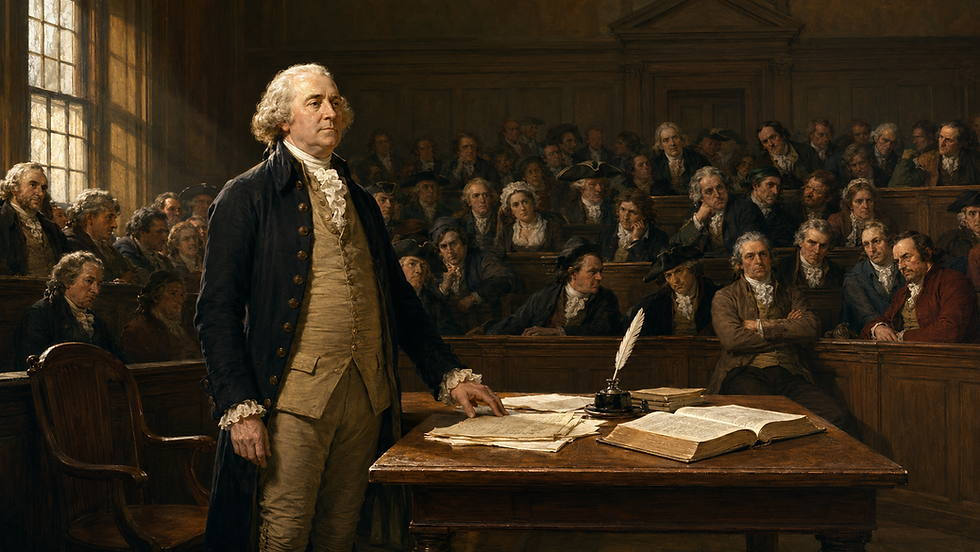
Last week we pictured the responsible citizen sitting at his desk. Before him were papers, a pamphlet or newspaper, a quill, and an open Bible. He was not a president, senator, general, or famous Founder. He was an ordinary citizen trying to understand the affairs of his community before deciding how he should act.
Perhaps this week we should imagine two papers lying before him.
They tell the story differently.
One account appeals immediately to what he already believes. The other complicates the matter. He could choose whichever version is most comfortable. He could accept the account preferred by his friends. He could believe the one that confirms his suspicions.
Or he could do the harder work of judgment.
Madison understood that people who intend to govern themselves must possess knowledge. Scripture demands something still deeper: the wisdom to seek truth, the patience to listen, and the humility to be corrected.
A free people must therefore be more than informed. They must be discerning.
We will never eliminate falsehood from public life. There were rumors, distortions, propaganda, partisan newspapers, and political accusations in the Founders' generation, just as there are unreliable claims in ours. New technologies may change the speed and reach of information, but they have not changed the human heart that receives it.
That is why the responsibility eventually returns to us.
Before I share it, have I tried to determine whether it is true?
Before I become angry, have I heard the whole matter?
Before I accuse someone else of bias, have I examined my own?
Before I demand honesty from institutions, leaders, journalists, and neighbors, have I committed myself to honesty?
And beneath all of those questions remains the one we may need most:
Do I want to know what is true—or do I simply want to be told that what I think is true?
A person willing to answer that question truthfully has already begun the work of discernment.
And a people willing to do the same have taken another necessary step toward becoming capable of governing themselves.
Spirit & Truth,
Thom H. Paine
Notes
Thomas Jefferson to Edward Carrington, January 16, 1787, in The Papers of Thomas Jefferson, vol. 11, January 1–August 6, 1787, ed. Julian P. Boyd (Princeton, NJ: Princeton University Press, 1955), 48–49. Jefferson argued for keeping citizens informed through public papers and famously contrasted “a government without newspapers” with “newspapers without a government.”
James Madison to W. T. Barry, August 4, 1822, in The Writings of James Madison, vol. 9, ed. Gaillard Hunt (New York: G. P. Putnam's Sons, 1910), 103. Madison connected popular government, public information, education, and the knowledge necessary for self-government. The Library of Congress preserves the manuscript.
Thomas Jefferson to John Norvell, June 11, 1807, Thomas Jefferson Papers, Library of Congress. Asked about the proper conduct of a newspaper, Jefferson advocated “true facts & sound principles” before offering a sweeping and highly critical assessment of the newspaper press of his day.
Bibliography
Jefferson, Thomas. Letter to Edward Carrington. January 16, 1787. In The Papers of Thomas Jefferson. Vol. 11, January 1–August 6, 1787. Edited by Julian P. Boyd. Princeton, NJ: Princeton University Press, 1955.
———. Letter to John Norvell. June 11, 1807. Thomas Jefferson Papers. Library of Congress, Washington, DC.
Madison, James. Letter to W. T. Barry. August 4, 1822. In The Writings of James Madison. Vol. 9. Edited by Gaillard Hunt. New York: G. P. Putnam's Sons, 1910.
The Holy Bible, New International Version. Grand Rapids, MI: Zondervan, 2011.
The Founders’ Quill seeks to recover the spiritual and moral foundations that shaped the American experiment in ordered liberty. By returning to Scripture, history, and the wisdom of those who came before us, we are invited not merely to admire our inheritance but to become people capable of preserving it.


Comments